Shares of Schrödinger, Inc. gapped higher pre-market Thursday after reporting better-than-expected earnings.
The stock had closed at $11.80 and opened at $13.00 before pulling back, last trading around $12.40 on volume of 706,638 shares.
Despite the headline beat, investor reaction was muted.
While the company topped EPS expectations, the move suggested much of the good news had already been priced in.
The market appeared to anticipate a stronger quarter, limiting upside momentum.
In short, the EPS beat was notable, but persistent cash burn and structural losses kept enthusiasm contained, explaining the relatively flat follow-through in the stock.
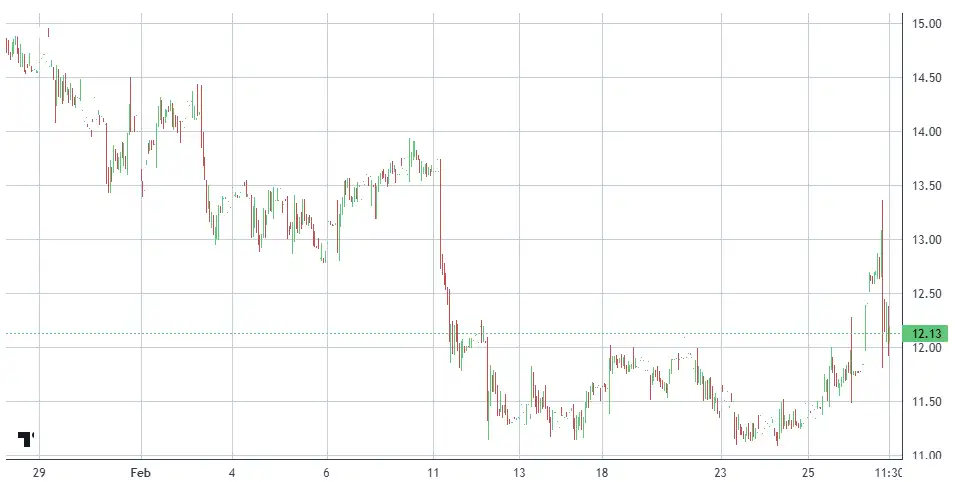
Since our starter initiation, the stock has pulled back 22%.
At these levels, we believe the risk-reward has improved materially and meaningful value is emerging.
From a valuation standpoint, SDGR trades at roughly 3x 2026 consensus revenue a level we view as disconnected from the long-term potential of its computational platform and growing role in AI-driven drug discovery.
For investors seeking AI exposure in healthcare without the full binary risk of clinical trial outcomes, SDGR remains a compelling way to express that theme.
Looking ahead, focus shifts to 2026 software ACV guidance and management’s target of reaching positive adjusted EBITDA by year-end 2028. While Q4 offered reassurance, expectations had already reset lower.
For those reasons, we are maintaining our 2026 price objective of $28.
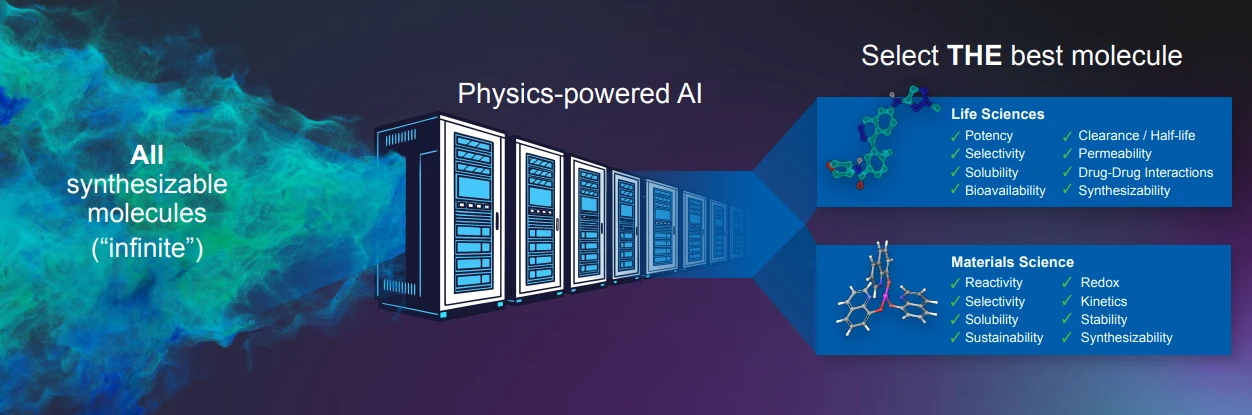
Schrödinger, Inc. is a life sciences and materials discovery company focused on applying physics-based computational platforms to accelerate drug development and advanced materials design.
Founded in 1990 by Professor Richard A. Friesner, the company has built a suite of proprietary tools including Maestro (molecular modeling), Glide (molecular docking), and Jaguar (quantum chemistry) designed to predict molecular behavior with high precision.
Platform Overview
Schrödinger addresses the persistent challenge of data scarcity in molecular discovery by combining ground-truth physics simulations with artificial intelligence. This hybrid approach allows researchers to design higher-quality drug candidates and materials more efficiently.
Recent highlights include:
RetroSynth: An AI-driven retrosynthesis solution that helps chemists rapidly identify efficient synthetic pathways for novel molecules, reducing manual design time and minimizing costly lab failures.
Lilly TuneLab Collaboration: Integration of LiveDesign as a priority interface for biotech users accessing TuneLab workflows
Strategic Agreement with Manas AI: Granting Manas AI access to Schrödinger’s computational platform to integrate physics-based modeling with proprietary algorithms, enhancing speed and predictive accuracy.
Business Model Transition
Leadership is actively shifting toward a hosted software model, accepting short-term financial pressure in exchange for longer-term recurring revenue benefits. The company targets roughly 75% of contracts being hosted by 2028 a structural change that impacts revenue timing and margin recognition.
The healthcare software space remains highly competitive, and regulatory dynamics can influence customer spending.
Still, Schrödinger’s move toward throughput-based licensing and continued platform innovation could serve as long-term catalysts.
2025 Performance Overview
Revenue growth was accompanied by improving cost discipline. Operating expenses declined 9% year over year, signaling better operational efficiency even as the company continues investing in its platform and hosted software transition.
However, profitability remains a work in progress. The operating margin stood at -66.3%, reflecting continued investment and structural transition costs.
That said, the net loss narrowed meaningfully compared to the prior year.
Full-Year 2025 Financial Highlights
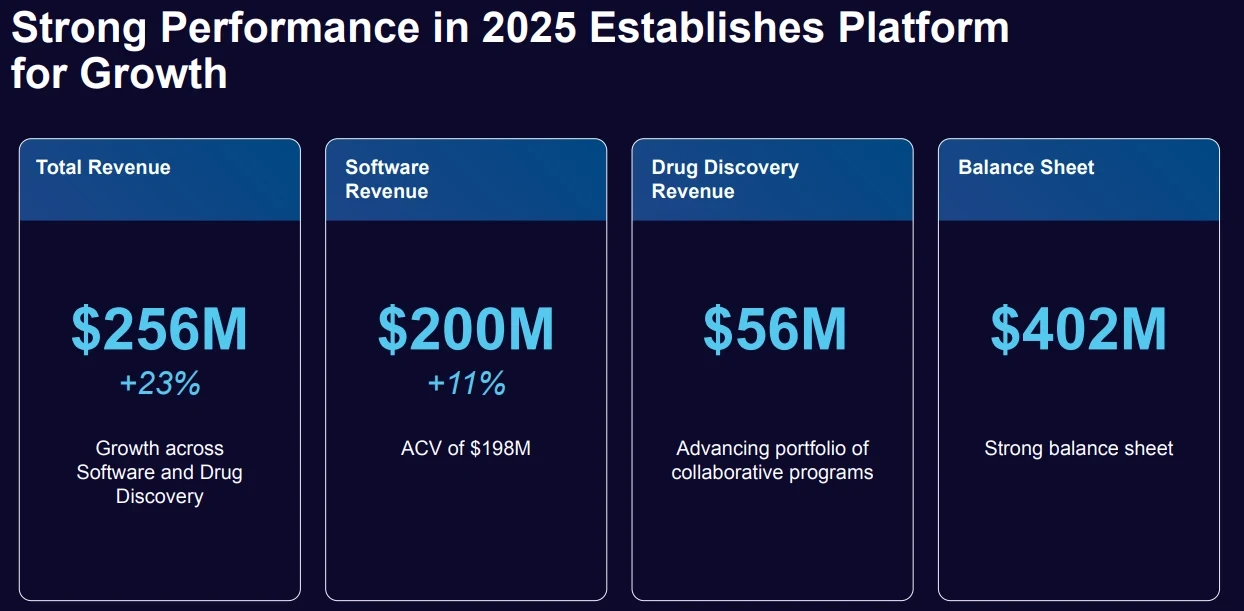
Total Revenue: $255.9 million (+23.3%)
Software Revenue: $199.5 million (+10.6%)
Drug Discovery Revenue: $56.4 million (vs. $27.2 million in 2024)
Software Gross Margin: 74%
Operating Expenses: $309.5 million (-9.3%)
Other Income: $64.6 million (includes equity investment gains/losses and interest income)
Net Loss: $103.3 million (improved from $187.1 million)
Cash & Marketable Securities (Dec 31, 2025): $402.3 million (vs. $367.5 million in 2024)
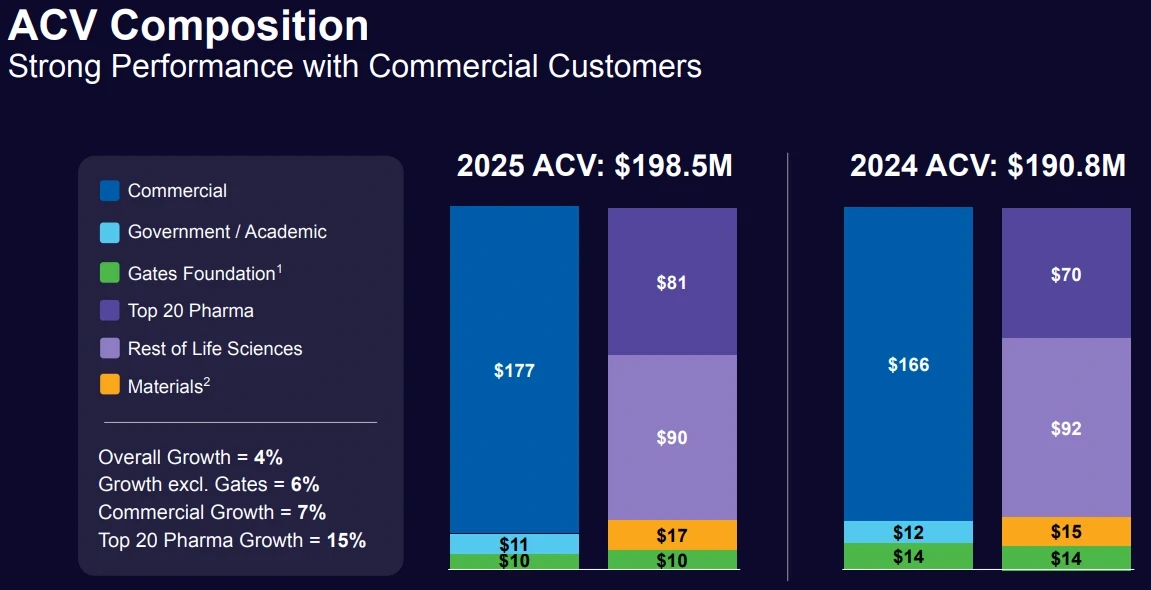
Schrödinger, Inc. outlined its 2026 outlook alongside longer-term financial objectives through 2028, reinforcing its focus on durable ACV growth, margin recovery, and a return to positive adjusted EBITDA.
2026 Financial Outlook
For the fiscal year ending December 31, 2026, management expects:
Software ACV: $218 million to $228 million, representing 10–15% growth over 2025.
Drug Discovery Revenue: $55 million to $65 million.
Operating Expenses: Lower than 2025 levels, reflecting continued cost discipline.
For Q1 2026 specifically, software ACV is projected between $24 million and $28 million, equating to $197 million to $201 million on a trailing four-quarter basis.
The guidance reflects steady core software demand despite the revenuerecognition impact of the hosted transition.
2028 Financial Objectives
Looking further out, Schrödinger is targeting positive adjusted EBITDA by yearend 2028, supported by the following priorities:
Durable Software ACV Growth: Sustain 10–15% annual growth.
Hosted Software Transition: Largely complete the shift to hosted contracts as reported revenue converges with ACV.
Gross Margin Recovery: Restore software gross margins to the high-70% range.
Drug Discovery Revenue: Target approximately $50 million annually, with variability tied to milestone timing.
Expense Discipline & Cash Flow: Drive operating leverage to achieve positive adjusted EBITDA.
Overall, management is signaling a multi-year execution plan: stabilize growth during the hosted transition in 2026, expand margins through operational discipline, and position the company for profitability by 2028.
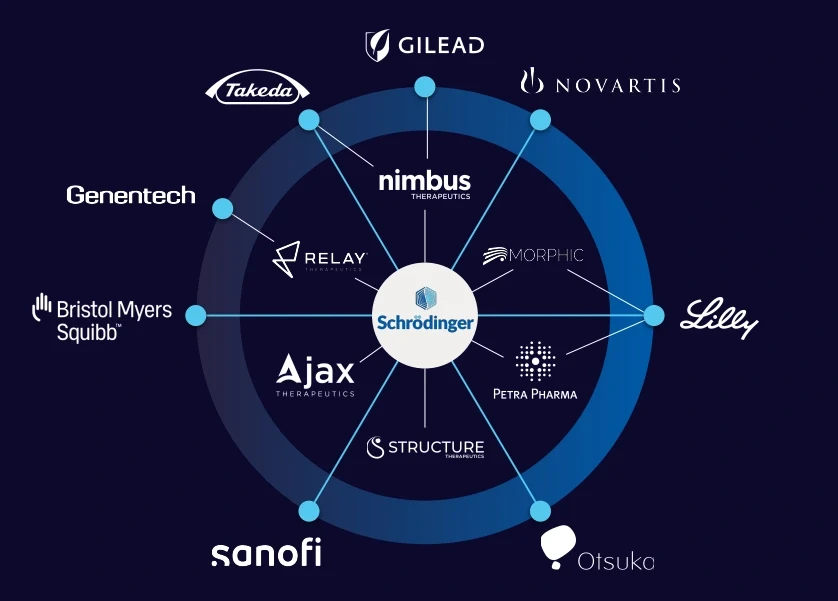
Schrödinger, Inc. is navigating a critical stretch as it works toward its 2028 objectives.
Management is clearly prioritizing long-term platform value over near-term optics, but the next 12–18 months will likely determine whether that strategy translates into sustainable growth and profitability.
Key Catalysts
WEE1/Myt1 Phase I Data (Q2): Positive clinical readouts could unlock incremental value within the therapeutics pipeline and strengthen the broader investment narrative.
Agentic AI Integration with Anthropic: The partnership, structured under a throughput licensing model, is designed to enhance the platform’s capabilities, support software ACV growth, and accelerate the hosted transition by increasing customer engagement and stickiness.
Main Risks
The most material challenge remains execution of the hosted transition. For every 1% increase in hosted contracts, annual revenue declines by approximately $2–$3 million due to revenue recognition dynamics. This makes hitting the 2026 ACV target of $218–$228 million essential. A shortfall would raise concerns about sales momentum and long-term cash sustainability.
With roughly $400 million in cash, capital allocation discipline is critical. The hosted shift temporarily compresses margins and delays revenue recognition, increasing the risk of elevated cash burn if growth targets are missed.
Ultimately, achieving positive adjusted EBITDA by 2028 becomes a timing equation. Success depends on balancing disciplined expense control with software growth, AI-driven platform adoption, and meaningful clinical progress.
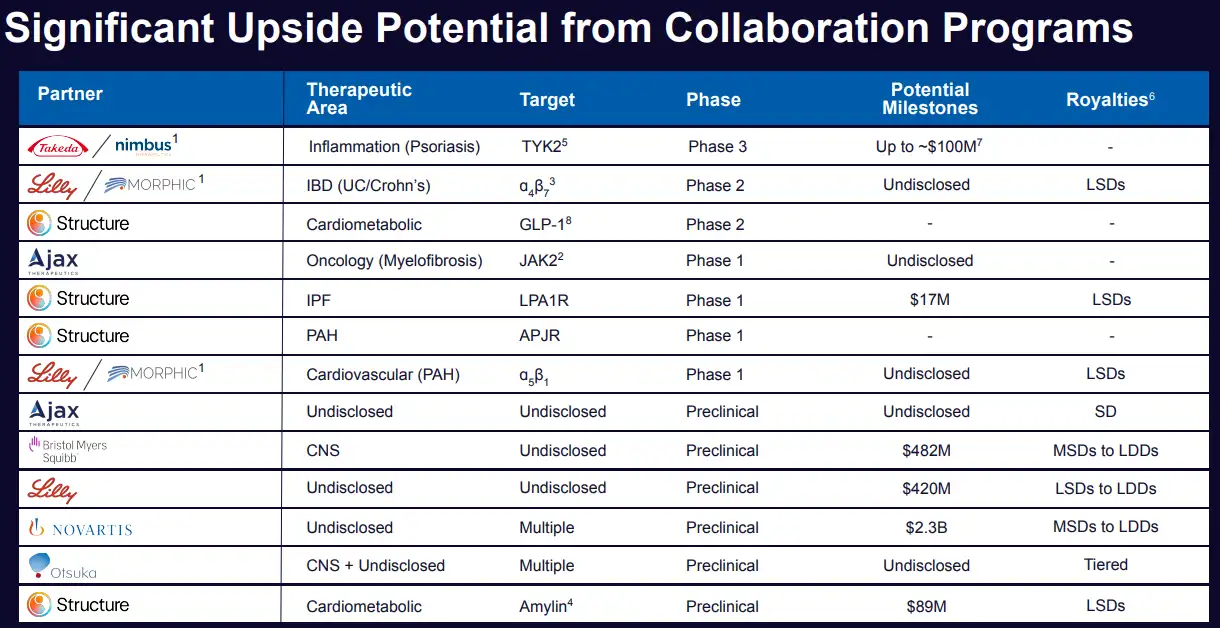
Schrödinger, Inc. continues to advance a broad therapeutics portfolio built on its predict-first drug design platform.
The company now supports more than 25 first-in-class, best-in-class, and firstin-modality programs, including over 10 in clinical development.
Sixteen programs are royalty-eligible, creating long-term downstream revenue potential.
Since 2020, Schrödinger has generated over $650 million in cash from drug discovery partnerships and remains eligible for nearly $5 billion in potential future milestone payments.
Key Program Highlights
SGR-1505 & SGR-3515:
Schrödinger is finalizing Phase 1 clinical packages for SGR-1505, a MALT-1 inhibitor targeting relapsed or refractory B-cell malignancies, and SGR-3515, a Wee1/Myt1 inhibitor for solid tumors. Initial data for SGR-3515 is expected in Q2 2026. The company is also evaluating strategic partnership opportunities to advance both programs.
Structure Therapeutics:
Co-founded by Schrödinger, Structure reported positive Phase 2B topline data for aleniglipron, a once-daily oral GLP-1 receptor agonist for obesity, and plans to begin Phase 3 trials in mid-2026. The company also initiated a first-inhuman Phase 1 trial for ACCG-2671, an oral amylin receptor agonist. Schrödinger maintains an equity stake.
Ajax Therapeutics:
Ajax presented preclinical data on AJ1-11095, a first-in-class type II JAK2 inhibitor currently in Phase 1 trials for relapsed/refractory myelofibrosis, at the American Society of Hematology Annual Meeting. The program also received orphan drug designation from the U.S. Food and Drug Administration.
Takeda Pharmaceutical Company & Zasocitinib:
Takeda announced positive Phase 3 results for zasocitinib, an investigational TYK2 inhibitor for moderate-to-severe plaque psoriasis, and plans to file a New Drug Application in 2026. The drug was originally developed by Nimbus, a company co-founded by Schrödinger. The company remains eligible for future milestone-related cash distributions tied to sales performance.
Strategic Takeaway
Schrödinger’s therapeutics portfolio adds a second engine of potential value creation beyond software. While milestone timing introduces variability, the depth of clinical-stage assets, royalty eligibility, and equity stakes in partner companies provide meaningful long-term optionality particularly if upcoming Phase 1 and Phase 3 readouts trend positively.
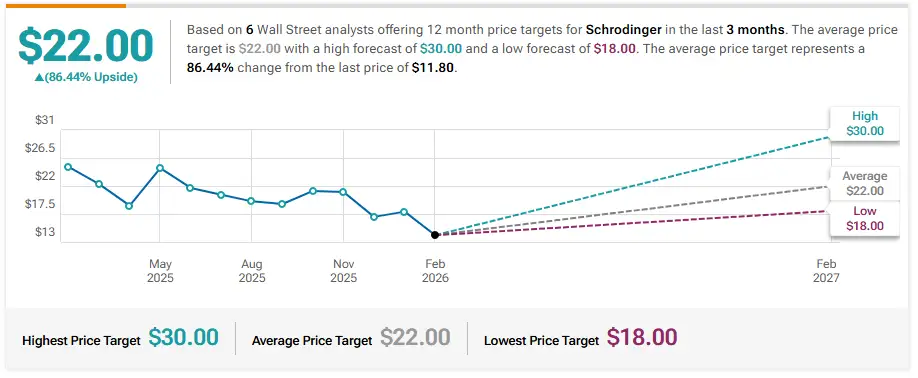
TD Cowen Maintains Buy on Schrodinger, Lowers Price Target to $24
Keybanc Maintains Overweight on Schrodinger, Lowers Price Target to $25
Schrodinger price target raised to $19 from $18 at Morgan Stanley
Schrodinger price target lowered to $25 from $28 at KeyBanc
